Suburb SEO is how aged care providers get found in local searches. Without it, your website won’t show up when families search for care in a specific suburb. It’s something the team at Matter Solutions comes across constantly.
As a provider, losing families to competitors who simply ranked higher is a tough pill to swallow. Frankly, strong services deserve strong visibility, and the two don’t always line up without the right website structure behind them.
With that in mind, this guide covers Google’s ranking signals, your Business Profile, suburb page structure, and the habits that hold your rankings over time.
Stick around, because what’s in here could change how families in your area find you.
Why Suburb SEO Works Differently for Aged Care Providers
Unlike general SEO, suburb SEO targets the way families search for aged care by location. These searches are hyper-local by nature, and Google ranks results to match.
Google ranks suburb-based searches using three signals: where your business is located, what your pages say, and how trusted your site is.
For example, some of the best-looking aged care sites we’ve audited don’t show up in a single suburb search. These three reasons explain why:
- Location Gap: When someone searches for aged care in Chermside or Parramatta, Google looks for a page built around that location specifically. Without one, your business won’t appear in that search at all.
- Specific Wins: A general services page and a dedicated suburb page aren’t the same thing in Google’s eyes. Frankly, suburb-specific pages rank significantly higher for aged care searches, and a broad page will lose that competition every time.
- Missed Searches: Most aged care providers don’t have suburb-specific pages, so Google has nothing local to rank them for. That hands visibility directly to competitors who built those pages first.
Suburb pages are where that visibility starts, and understanding what Google looks for is the logical next step.
The Signals Google Uses to Rank Suburb-Based Results
Google ranks suburb-based searches using three signals: where your business is located, what your pages say, and how trusted your site is.
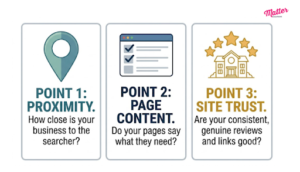
Think of those three signals like a job interview checklist. One missing box and Google calls your competitor instead (most providers only focus on one).
Of the three, proximity comes first. It tells Google how close your business is to the searcher. Page content, on the other hand, determines if your pages match what the searcher is looking for. Site authority, the most overlooked signal, comes down to consistent listings, genuine reviews, and pages built around your services.
According to how Google reads and ranks pages, Google uses a range of signals to assess site quality, and consistent, relevant content sits at the centre of that.
With all three signals working together, your Google Business Profile becomes the foundation that ties them.
Your Google Business Profile and Local SEO Work Together
A fully optimised Google Business Profile gives your suburb pages a stronger foundation to rank on. In fact, our team has audited hundreds of aged care provider profiles, and an incomplete profile is the most common gap we find.
And across those hundreds of audits, three patterns keep coming up:
- Address and Area: Google pulls your service area, address, and business category directly from your profile. If those details are off, your suburb pages won’t rank where they should, regardless of how well they’re built.
- Profile Completeness: Ever seen a business listed differently across three different directories? Google notices that too. In fact, inconsistent details across listings confuse Google, and that confusion costs you rankings.
- Visibility Gap: A patchy profile is quietly holding back your suburb pages. Most providers are surprised to hear this. But based on what we’ve seen, fixing the profile alone is often the quickest win for suburb search rankings.
An outdated profile quietly undermines suburb pages that are otherwise well-built. Keep it current, and it works in your favour every time a family searches locally.
How to Build Suburb Pages That Rank
To build suburb pages that rank, you need the right locations and the right content on each page. Without them, suburb pages are like shops on streets your customers never walk down.
Start with the suburbs, then focus on what goes on each page.
Choosing the Right Suburbs to Target First
Your existing service areas are the logical starting point. Google can cross-reference your profile, reviews, and existing citations there, which gives those pages a stronger starting point in local search. That said, a little research upfront saves a lot of wasted effort.
Look for:
- Suburbs where you already have clients or citations
- Areas with search volume but low aged care competition
- Locations close enough for Google to verify your proximity
- Suburbs with a high proportion of older residents
On the flip side, spreading too wide too early dilutes your SEO authority before any single page gains traction.
What to Include on Each Suburb Page
Every suburb page needs a specific set of elements to rank well in local search. These are the details Google looks for, and families rely on:
- Suburb Name Placement: The suburb name belongs in the page title, URL, and opening paragraph. Google uses all three to confirm if the page is relevant to that area.
- Service Description: A location-specific description of your aged care services tells Google what you offer in that suburb. It also gives families a reason to stay on the page.
- Local Details: Pages that reference nearby landmarks, community centres, or hospitals feel local because they are.
- Contact Path: Families searching for aged care locally want to reach someone quickly. A phone number, a physical address, and a simple enquiry form on every page remove any friction between the search and the call.
- Client Reviews: Genuine reviews that mention the suburb by name signal location relevance to Google and give families a reason to choose you over a competitor.
Every page on your site should read like it was written for that suburb specifically. Besides, Google can tell the difference between a page built for people and one built just to rank.
The Habits That Hold Your Rankings
Suburb page rankings respond directly to how well they’re maintained over time. The providers who hold their rankings do three things consistently: update their pages, collect location-specific reviews, and stay the course.
Let’s break each one down:
- Stay Current: Google treats a stale suburb page like an outdated brochure. A quick refresh every few months keeps your content current and your pages competitive in local search.
- Collect Reviews: Instead of a review, ask clients to mention their suburb by name. That one detail adds location relevance Google picks up on every time a review comes in.
- Be Consistent: Steady updates and reviews over 3 to 6 months is when suburb pages start climbing. That window is where rankings are won or lost.
Volume without upkeep does nothing for your rankings. We’ve seen it happen too many times, a smaller set of well-maintained pages will always outperform a larger set of neglected ones.
Ready to Show Up Where Your Clients Are Searching?
Aged care providers who invest in suburb SEO start showing up where families are actively searching. Every section in this guide gives you a concrete step to move toward that.
To recap, we covered the three signals Google checks and how to set up your Business Profile. Beyond that, we looked at what every suburb page needs to rank and the habits that hold those rankings over time. Each one builds on the last.
So if you’re ready to take action, the team at Matter Solutions has helped aged care providers across Australia rank in the suburbs they serve. Our team will take you through every step you need to start ranking in the suburbs you serve.
Get in touch today.