Technology

unnamed 2026 07 13t200134.362

How Aged Care Providers Can Rank for Suburb Based Searches

Suburb SEO is how aged care providers get found in local searches. Without it, your website won’t show up when families search for care in a specific suburb. It’s something the team at Matter Solutions comes across constantly. As a provider, losing families to competitors who simply ranked higher is a tough pill to swallow. Frankly, strong services deserve strong visibility, and the two don’t always line up without the right website structure behind them.  With that in mind, this guide covers Google’s ranking signals, your Business Profile, suburb page structure, and the habits that hold your rankings over time. Stick around, because what’s in here could change how families in your area find you. Why Suburb SEO Works Differently for Aged Care Providers Unlike general SEO, suburb SEO targets the way families search for aged care by location. These searches are hyper-local by nature, and Google ranks results to match. f Google ranks suburb-based searches using three signals: where your business is located, what your pages say, and how trusted your site is. For example, some of the best-looking aged care sites we’ve audited don’t show up in a single suburb search. These three reasons explain why: Location Gap: When someone searches for aged care in Chermside or Parramatta, Google looks for a page built around that location specifically. Without one, your business won’t appear in that search at all.  Specific Wins: A general services page and a dedicated suburb page aren’t the same thing in Google’s eyes. Frankly, suburb-specific pages rank significantly higher for aged care searches, and a broad page will lose that competition every time. Missed Searches: Most aged care providers don’t have suburb-specific pages, so Google has nothing local to rank them for. That hands visibility directly to competitors who built those pages first. Suburb pages are where that visibility starts, and understanding what Google looks for is the logical next step. The Signals Google Uses to Rank Suburb-Based Results Google ranks suburb-based searches using three signals: where your business is located, what your pages say, and how trusted your site is. Think of those three signals like a job interview checklist. One missing box and Google calls your competitor instead (most providers only focus on one). Of the three, proximity comes first. It tells Google how close your business is to the searcher. Page content, on the other hand, determines if your pages match what the searcher is looking for. Site authority, the most overlooked signal, comes down to consistent listings, genuine reviews, and pages built around your services. According to how Google reads and ranks pages, Google uses a range of signals to assess site quality, and consistent, relevant content sits at the centre of that. With all three signals working together, your Google Business Profile becomes the foundation that ties them.   Your Google Business Profile and Local SEO Work Together A fully optimised Google Business Profile gives your suburb pages a stronger foundation to rank on. In fact, our team has audited hundreds of aged care provider profiles, and an incomplete profile is the most common gap we find. And across those hundreds of audits, three patterns keep coming up: Address and Area: Google pulls your service area, address, and business category directly from your profile. If those details are off, your suburb pages won’t rank where they should, regardless of how well they’re built. Profile Completeness: Ever seen a business listed differently across three different directories? Google notices that too. In fact, inconsistent details across listings confuse Google, and that confusion costs you rankings. Visibility Gap: A patchy profile is quietly holding back your suburb pages. Most providers are surprised to hear this. But based on what we’ve seen, fixing the profile alone is often the quickest win for suburb search rankings. An outdated profile quietly undermines suburb pages that are otherwise well-built. Keep it current, and it works in your favour every time a family searches locally. How to Build Suburb Pages That Rank To build suburb pages that rank, you need the right locations and the right content on each page. Without them, suburb pages are like shops on streets your customers never walk down. Start with the suburbs, then focus on what goes on each page. Choosing the Right Suburbs to Target First Your existing service areas are the logical starting point. Google can cross-reference your profile, reviews, and existing citations there, which gives those pages a stronger starting point in local search. That said, a little research upfront saves a lot of wasted effort. Look for: Suburbs where you already have clients or citations Areas with search volume but low aged care competition Locations close enough for Google to verify your proximity Suburbs with a high proportion of older residents On the flip side, spreading too wide too early dilutes your SEO authority before any single page gains traction. What to Include on Each Suburb Page Every suburb page needs a specific set of elements to rank well in local search. These are the details Google looks for, and families rely on: Suburb Name Placement: The suburb name belongs in the page title, URL, and opening paragraph. Google uses all three to confirm if the page is relevant to that area. Service Description: A location-specific description of your aged care services tells Google what you offer in that suburb. It also gives families a reason to stay on the page. Local Details: Pages that reference nearby landmarks, community centres, or hospitals feel local because they are.   Contact Path: Families searching for aged care locally want to reach someone quickly. A phone number, a physical address, and a simple enquiry form on every page remove any friction between the search and the call. Client Reviews: Genuine reviews that mention the suburb by name signal location relevance to Google and give families a reason to choose you over a competitor. Every page on your site should read like it was written for that suburb specifically. Besides, Google can

How Aged Care Providers Can Rank for Suburb Based Searches Read Post »

What Is CDT Time

What Is CDT Time? Understanding Central Daylight Time

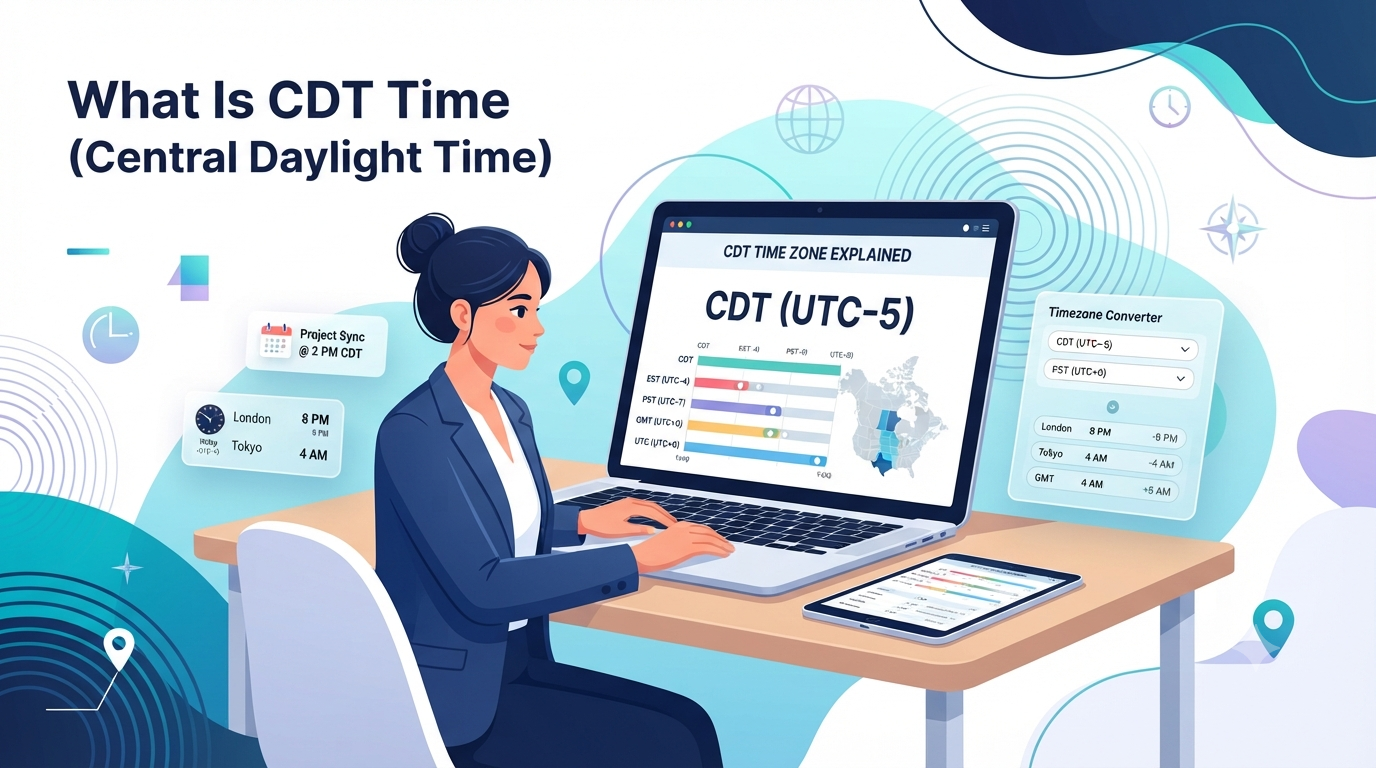
If you've ever scheduled a meeting with someone in the central United States or checked the time for a flight, you've probably come across the abbreviation CDT. But what is CDT time, and how does it differ from other time zones? Central Daylight Time (CDT) is one of the primary time zones used in North America during the daylight saving period. It helps millions of people coordinate business, travel, education, and communication across different regions. However, because the time changes seasonally, many people find it confusing to know when CDT is in effect and how it compares to other time zones. In this guide, we'll explain what CDT means, where it is used, how it relates to Coordinated Universal Time (UTC), and why understanding it is important for anyone working or communicating across time zones. CDT stands for Central Daylight Time. It is the daylight saving version of the Central Time Zone observed in many parts of North America. During the daylight saving season, clocks are moved forward by one hour. This shift allows for more daylight during the evening hours while reducing daylight in the early morning. Central Daylight Time operates at UTC−5, meaning it is five hours behind Coordinated Universal Time (UTC). When daylight saving ends, regions using CDT switch back to Central Standard Time (CST), which follows UTC−6. The concept of daylight saving time was introduced to make better use of natural daylight. Instead of having the sun rise and set earlier in the day, clocks are adjusted forward during the warmer months. The benefits often associated with daylight saving include: More daylight after work or school Better visibility during evening activities Reduced need for artificial lighting Improved opportunities for outdoor recreation Although daylight saving remains widely practiced in North America, not every country or region observes it. Every global time zone is measured in relation to Coordinated Universal Time (UTC), the international standard for timekeeping. Central Daylight Time uses the following offset: CDT = UTC−5 This means that local time in the CDT zone is always five hours behind UTC while daylight saving is in effect. For example: UTC Time Central Daylight Time 12:00 PM 7:00 AM 3:00 PM 10:00 AM 8:00 PM 3:00 PM Knowing the UTC offset makes it easier to convert between different time zones accurately. Central Daylight Time is observed across a large portion of North America during daylight saving months. United States Many states use CDT, including: Texas Illinois Alabama Arkansas Louisiana Mississippi Missouri Oklahoma Iowa Wisconsin Minnesota Kansas Some states are divided between multiple time zones, meaning only certain regions observe Central Daylight Time. Examples include: Florida Indiana Kentucky Nebraska North Dakota South Dakota Tennessee Canada Parts of Canada also follow Central Daylight Time during the summer months. These include areas within: Manitoba Ontario Nunavut Portions of Saskatchewan Because provincial rules may vary, local time should always be verified before scheduling meetings or travel. One of the most common sources of confusion is the difference between Central Daylight Time (CDT) and Central Standard Time (CST). Although they belong to the same Central Time Zone, they are used during different times of the year. Central Daylight Time (CDT) Central Standard Time (CST) UTC−5 UTC−6 Spring and summer Fall and winter Daylight Saving Time Standard Time Clock moved forward one hour Regular local time When daylight saving begins, clocks advance by one hour, changing the time zone from CST to CDT. When daylight saving ends, clocks return to CST. In the United States, Central Daylight Time typically starts on the second Sunday in March. At 2:00 AM, clocks are moved forward one hour to 3:00 AM. This change remains in effect until the first Sunday in November, when clocks are moved back one hour and Central Standard Time resumes. Although these dates are generally consistent each year, it's always wise to confirm current daylight saving schedules if you're coordinating across countries. Understanding how Central Daylight Time relates to other major time zones can make scheduling much easier. Here are some common comparisons: Time Zone Difference from CDT Eastern Daylight Time (EDT) 1 hour ahead Mountain Daylight Time (MDT) 1 hour behind Pacific Daylight Time (PDT) 2 hours behind Alaska Daylight Time (AKDT) 3 hours behind Hawaii Standard Time (HST) 5 hours behind Internationally, the difference depends on whether the other country also observes daylight saving time. Many people regularly convert Central Daylight Time to other global time zones. Some popular conversions include: CDT to Eastern Time Eastern Daylight Time is one hour ahead. Example: 9:00 AM CDT = 10:00 AM EDT CDT to Pacific Time Pacific Daylight Time is two hours behind. Example: 4:00 PM CDT = 2:00 PM PDT CDT to UTC Add five hours. Example: 2:00 PM CDT = 7:00 PM UTC CDT to GMT Since GMT closely aligns with UTC for everyday use, add five hours. CDT to India Standard Time India Standard Time is significantly ahead of CDT. Example: 8:00 AM CDT = 6:30 PM IST Rather than calculating these differences manually, an online time zone converter provides quick and accurate results. Understanding Central Daylight Time isn't only useful for travelers. It plays an important role in everyday life for businesses, students, and remote workers. Knowing CDT helps with: Business Communication Many companies operate across multiple states or countries. Accurate time conversion ensures meetings begin on schedule. Remote Work Distributed teams often include members working from different time zones. Understanding CDT helps everyone stay aligned. Travel Planning Flight departures, hotel check-ins, and transportation schedules often use local time. Knowing whether a destination follows CDT can prevent costly mistakes. Online Learning Students attending virtual classes hosted in Central Time need to convert schedules correctly. Live Events Sports broadcasts, webinars, concerts, and product launches frequently announce times in Central Time. Although you can manually calculate time differences, doing so isn't always reliable. Daylight saving changes, regional exceptions, and international time differences can easily cause confusion. Using a dedicated time zone converter offers several advantages: Instant time conversion Automatic daylight saving adjustments

What Is CDT Time? Understanding Central Daylight Time Read Post »

How AI Is Transforming Modern Gaming Beyond Better Graphics

How AI Is Transforming Modern Gaming Beyond Better Graphics

The integration of artificial intelligence (AI) in gaming has revolutionized the industry in ways that transcend mere visual enhancements. While stunning graphics have long captured the imaginations of players, the real transformation is occurring beneath the surface, where AI is redefining gameplay mechanics, enhancing player experiences, and creating virtual worlds that are as dynamic as they are immersive. This comprehensive guide explores the multifaceted impact of AI on modern gaming, uncovering how it enhances gameplay mechanics, personalizes experiences, and reshapes the future of interactive entertainment. Introduction to AI's Role in Gaming Artificial intelligence in video games is no longer a futuristic concept; it’s a vital component of current game design and development. AI’s influence extends beyond graphics, encompassing game mechanics, player engagement, and adaptive environments. As the gaming industry continues to grow, understanding the nuances of AI's role becomes essential for both developers and players. AI-Driven Game Design Procedural Content Generation One of the most significant contributions of AI to game design is procedural content generation. This technology allows developers to create expansive game worlds without the need for manual input. AI algorithms autonomously generate levels, quests, and environments, ensuring each player's experience is unique. Games like No Man's Sky have leveraged procedural generation to create vast, explorable universes that encourage endless exploration. Dynamic Storytelling AI-driven storytelling is transforming narrative experiences in games. By analyzing player choices and preferences, AI can adapt storylines in real-time, offering a personalized narrative journey. This dynamic approach is evident in games like Detroit: Become Human, where player decisions significantly impact the story's outcome, creating a tailored experience. AI in Game Testing and Quality Assurance AI plays a crucial role in enhancing game testing and quality assurance processes. Automated testing tools powered by machine learning algorithms can efficiently identify bugs and ensure seamless gameplay. This not only accelerates development timelines but also enhances the overall quality of the game. Developers and technology enthusiasts looking to explore broader applications of artificial intelligence can also refer to AI technology resources covering automation, machine learning, and emerging software innovations. AI and Player Experience Personalized Gaming Experiences Personalization is at the forefront of AI enhancements in gaming. By analyzing player behavior and preferences, AI can customize game elements such as difficulty levels, challenges, and rewards. This personalization is pivotal in maintaining player engagement and retention, as it ensures a tailored experience that resonates with individual players. Adaptive Difficulty Levels AI-driven adaptive difficulty levels adjust in real-time to match a player's skill, providing an optimal challenge without causing frustration. This feature is particularly beneficial in maintaining a balanced gameplay experience, where players feel continuously engaged without the game becoming too easy or impossibly difficult. AI in Multiplayer Gaming Smarter NPCs and Bots The evolution of non-player characters (NPCs) through AI has led to more intelligent and lifelike interactions. NPCs can now learn and adapt to player strategies, providing a more realistic and challenging opponent. This is evident in games like F.E.A.R., where AI-controlled enemies employ tactics that mimic human behavior, enhancing the multiplayer experience. Ethical Considerations in AI Gaming As AI continues to permeate the gaming industry, ethical considerations become increasingly important. Issues such as data privacy, AI decision-making transparency, and the potential for AI to influence player behavior require careful scrutiny. Developers must address these concerns to ensure that AI integration in games is responsible and ethical. Readers interested in protecting their digital activities and understanding modern online security practices can also explore cybersecurity and digital privacy insights to stay informed about evolving security challenges. Future Prospects and Innovations The future of AI in gaming promises exciting innovations, including enhanced virtual reality (VR) and augmented reality (AR) experiences, where AI creates more immersive and responsive environments. As AI technology advances, we can anticipate even more sophisticated player interactions, procedural content generation, and adaptive storytelling. Conclusion AI's transformative impact on modern gaming extends far beyond visual enhancements, reshaping how games are designed, experienced, and enjoyed. By focusing on elements such as personalized experiences, intelligent NPC behavior, and procedural content generation, AI continues to push the boundaries of what's possible in gaming. As developers and players alike navigate this AI-driven landscape, embracing these technologies will be key to unlocking new realms of interactive entertainment. FAQ How does AI affect gameplay mechanics beyond graphics?AI enhances gameplay mechanics by enabling procedural content generation, dynamic storytelling, and adaptive difficulty levels, all of which create more engaging and personalized gaming experiences. What are the latest AI technologies used in game development?Cutting-edge AI technologies in game development include machine learning algorithms for NPC behavior, procedural content generation techniques, and real-time adaptive systems for personalized player experiences. How can AI enhance player engagement and retention?AI enhances player engagement by personalizing game elements based on player behavior and preferences, ensuring an optimal balance between challenge and enjoyment to keep players invested. What ethical considerations should developers have when integrating AI into games?Developers should consider data privacy, transparency of AI decision-making processes, and the potential impact of AI on player behavior to ensure responsible and ethical AI integration. What games use AI for more than just graphics?Games like No Man's Sky and Detroit: Become Human utilize AI for procedural content generation and dynamic storytelling, respectively, showcasing the technology's impact beyond graphics. How does AI improve player engagement?AI improves player engagement by adapting the game experience to individual preferences, creating a dynamic and personalized environment that keeps players invested. What are the ethical concerns with AI in gaming?Ethical concerns include the potential misuse of player data, lack of transparency in AI decisions, and the influence AI may have on player behavior and decision-making. In exploring the comprehensive impact of AI on gaming, this guide provides a clear path for understanding and leveraging AI technologies to create richer, more immersive gaming experiences. Whether you're a developer seeking to enhance your games or a player eager to understand the nuances of AI-driven gaming, embracing these insights will help navigate the future of this dynamic industry.

How AI Is Transforming Modern Gaming Beyond Better Graphics Read Post »

How AI is Powering Digital Business Growth in 2026

How AI is Powering Digital Business Growth in 2026

Introduction In 2026, artificial intelligence is no longer just a support tool for businesses; it has become a core driver of how companies operate, compete, and expand. From small startups to large enterprises, AI is reshaping decision-making, customer engagement, marketing, and overall operational efficiency. Businesses are no longer relying on traditional methods alone. Instead, they are adopting intelligent systems that learn, adapt, and improve performance over time. The demand for faster results, smarter insights, and personalized customer experiences has pushed organizations to rethink their strategies. AI is now deeply embedded in almost every digital process, helping businesses reduce costs, improve accuracy, and scale faster than ever before. In this environment, growth is no longer just about having an online presence; it is about using intelligent systems that actively contribute to success. One of the most important shifts in this transformation is the way companies now view technology as a growth partner rather than just a tool. This mindset is redefining how businesses approach innovation and long-term success. The Role of AI in Modern Business Expansion Artificial intelligence plays a central role in shaping modern digital ecosystems. In 2026, businesses are using AI to analyze massive amounts of data in real time, enabling faster and more accurate decision-making. Instead of relying on guesswork, companies can now understand customer behavior, market trends, and operational gaps with high precision. AI-powered systems help organizations predict demand, optimize pricing strategies, and improve supply chain management. This level of insight was previously difficult and time-consuming to achieve. Now, it happens automatically and continuously. AI is also transforming how businesses interact with customers. Chat systems, recommendation engines, and personalized marketing campaigns are making customer experiences more relevant and engaging. This not only improves satisfaction but also increases conversion rates and long-term loyalty. Key AI Technologies Driving Business Growth In 2026, AI is playing a major role in shaping modern Digital Solutions for Business Growth, helping companies work faster, smarter, and more efficiently. These technologies are transforming how businesses operate, make decisions, and interact with customers.   Intelligent automation streamlines complex tasks like customer support, finance, and operations, reducing manual effort and improving productivity. Predictive analytics helps businesses forecast trends and make better decisions using data insights. Generative AI speeds up content creation, design, and marketing by producing high-quality outputs in less time. AI-driven customer experience enhances personalization by delivering tailored recommendations and faster support.   Together, these AI technologies are becoming essential tools for sustainable business growth in the digital era. 1. Intelligent Automation Automation has become more advanced with AI integration. It is no longer limited to repetitive tasks but now includes complex decision-making processes. Businesses use intelligent automation to handle customer support, financial reporting, inventory control, and even content generation. This reduces human workload and improves efficiency across departments. 2. Predictive Analytics Predictive analytics allows businesses to forecast future outcomes based on historical data. This helps companies prepare for market changes, customer demands, and potential risks. By identifying patterns early, businesses can make proactive decisions that improve performance and reduce uncertainty. 3. Generative AI Systems Generative AI is transforming content creation, product design, and digital marketing. Businesses can now generate personalized content, design prototypes, and develop creative assets in a fraction of the time. This speeds up innovation and allows teams to focus on strategy rather than manual production. 4. AI-Driven Customer Experience Customer experience has become one of the most important factors in business success. AI helps companies understand individual preferences and behavior, enabling highly personalized interactions. Whether it is product recommendations or automated support, AI ensures that customers receive faster and more relevant responses. How AI Supports Business Scalability Scalability is one of the biggest challenges for growing companies. AI solves this problem by allowing businesses to expand operations without significantly increasing costs. Cloud-based AI systems can handle large volumes of data and users without performance issues. Businesses can automate onboarding processes, streamline communication, and manage operations across multiple regions with minimal manual effort. This allows companies to grow faster while maintaining consistency and quality. AI also helps businesses enter new markets more confidently. By analyzing regional trends and customer behavior, companies can adapt their strategies to match local demand. This reduces risk and improves the chances of success in new areas. Real-World Applications of AI in Business Growth AI is being used across multiple industries to improve performance and accelerate growth. In e-commerce, AI helps recommend products and optimize pricing strategies. In healthcare, it supports diagnosis and patient management. In finance, it detects fraud and improves investment decisions. Marketing teams use AI to analyze audience behavior and create targeted campaigns that generate higher engagement. Sales teams rely on AI tools to identify potential leads and improve conversion rates. Even human resource departments use AI to streamline recruitment and employee management processes. These applications show that AI is not limited to one sector. It is a universal growth enabler that adapts to different business needs. Challenges in Adopting AI for Business Growth Despite its advantages, AI adoption comes with challenges. One of the biggest issues is data quality. AI systems depend on accurate and clean data to deliver reliable results. Poor data can lead to incorrect predictions and decisions. Another challenge is the lack of skilled professionals who can manage and implement AI systems effectively. Many businesses struggle to integrate AI into their existing workflows without proper expertise. There are also concerns about cost, security, and ethical usage. Companies must ensure that AI systems are used responsibly and that customer data is protected at all times. Balancing innovation with responsibility is essential for sustainable growth. The Future of AI in Digital Business The future of AI in business is focused on deeper integration and smarter decision-making. AI systems are expected to become more autonomous, handling complex tasks with minimal human input. This will further improve efficiency and reduce operational costs. Businesses will also see more advanced personalization, where every customer interaction is tailored in real time. Marketing, sales, and customer service will

How AI is Powering Digital Business Growth in 2026 Read Post »

nerovet ai dentistry

Nerovet AI Dentistry: The Quiet Revolution Reshaping Veterinary Oral Care

Why Pet Dental Care Is Finally Getting Serious Attention There was a time when pet dental care sat quietly at the bottom of the priority list. Vaccinations, injuries, diet—those felt urgent. Teeth? Not so much. That mindset is shifting fast, and not because of marketing hype, but because the consequences of ignoring oral health have become impossible to ignore. The emergence of Nerovet AI dentistry is happening right in the middle of this shift, where technology meets a long-overdue realization: dental health is foundational, not optional. Veterinary professionals have always understood the risks, but practical limitations slowed things down. Early detection was tricky. Many conditions stayed hidden beneath the gumline or progressed silently. Now, with solutions like the Nerovet AI dentistry pet dental health scanner, there’s a noticeable shift from reactive treatment to proactive care. It’s less about fixing damage and more about preventing it from happening in the first place. Another factor pushing this forward is pet owner awareness. People are asking better questions. They’re researching tools like nerovet ai dentistry website and looking for smarter, faster diagnostics. This isn’t just curiosity—it’s demand. And when demand meets innovation, industries evolve quickly. What makes this moment interesting is how naturally AI fits into the problem. Dental health produces visual and pattern-based data, which is exactly what AI thrives on. The result? A system that doesn’t just assist veterinarians—it enhances their ability to catch problems earlier and explain them more clearly. That’s the kind of change that sticks. Hidden Health Risks Behind Ignored Oral Issues Dental issues in pets don’t announce themselves loudly. They creep in quietly, building over time until they become serious. A bit of tartar, slight gum inflammation—easy to overlook. But under the surface, bacteria can spread, affecting vital organs and leading to chronic health problems. It’s not an exaggeration to say that untreated dental disease can shorten a pet’s life. This is where traditional methods often fall short. Visual exams only show part of the picture, and more detailed checks may require sedation. That creates a gap between suspicion and confirmation. Tools like the Nerovet AI dentistry pet dental scanner aim to bridge that gap by providing non-invasive, data-driven insights. Imagine being able to detect subtle changes in oral structure before they become visible problems. That’s the promise behind nerovet ai dentistry veterinary systems. Instead of waiting for symptoms, the technology identifies patterns that signal early-stage issues. It’s like having an extra layer of awareness—one that doesn’t get tired or miss details. For pet owners, this changes the emotional equation too. There’s less guesswork, less anxiety, and fewer surprises. When you can see a clear report generated through platforms like the nerovet ai dentistry official site, decisions become easier and more confident. The Shift Toward Preventive Veterinary Technologies Veterinary medicine is entering a phase where prevention is no longer just encouraged—it’s expected. And honestly, it makes sense. Preventing a condition is almost always easier, less expensive, and less stressful than treating it later. The rise of nerovet ai dentistry 2024 innovations shows how quickly this mindset is being adopted. AI plays a unique role here. It doesn’t replace expertise—it amplifies it. By analyzing thousands of data points, systems developed by the nerovet ai dental company nerovet ai dentistry can detect patterns that might not be obvious during a routine exam. This creates a new layer of diagnostic confidence. There’s also a scalability factor. Preventive tools are becoming more accessible, which means they can be used beyond traditional clinics. Mobile units, shelters, and even community outreach programs can integrate solutions from the nerovet ai dentistry company united states ecosystem. And let’s not ignore transparency. Pet owners want to understand what’s happening. AI-generated visuals and reports make that possible. It’s not just about being told there’s a problem—it’s about seeing it, understanding it, and acting on it. Inside Nerovet AI Dentistry and Its Growing Presence The story behind nerovet ai dentistry company isn’t just about building a product—it’s about identifying a gap that had been overlooked for years. Veterinary dentistry needed better tools, and instead of refining old methods, this company leaned into something entirely different: artificial intelligence. From its early stages, the focus appears to have been on combining hardware and software into a unified system. The nerovet ai dentistry company website reflects this integration, showcasing tools that aren’t just standalone devices but part of a broader diagnostic ecosystem. Growth hasn’t been accidental either. The increasing number of searches around nerovet ai dentistry firm and related terms suggests rising visibility and interest. This isn’t limited to one region; discussions around nerovet ai dentistry united states show that adoption is spreading across key veterinary markets. What’s particularly interesting is how the company positions itself—not just as a tech provider, but as a partner in clinical decision-making. That subtle shift in positioning makes a big difference in how professionals perceive and adopt the technology. The Story Behind Nerovet AI Dentistry Company Every innovation has a starting point, and in this case, it likely began with a simple question: why is dental diagnosis still so reactive? The answer led to the development of tools that prioritize early detection and data clarity. The nerovet ai dentistry company nerovet narrative centers around bridging gaps—between detection and treatment, between data and decision-making. By focusing on AI, the company tapped into a technology that thrives on pattern recognition, making it ideal for dental diagnostics. This approach also aligns with broader healthcare trends. AI is being used in radiology, dermatology, and now veterinary dentistry. It’s a natural progression, and nerovet ai dentistry official website showcases how that progression is being applied in real-world scenarios. Nerovet AI Dentistry Company 2024 to 2026 Growth Curve Looking at the timeline from nerovet ai dentistry company 2024 to nerovet ai dentistry company 2026, the growth trajectory reflects both technological refinement and market acceptance. Early versions focused on functionality, while newer iterations emphasize usability, speed, and integration. Search interest has grown alongside these developments. Terms like nerovet ai dentistry 2026

Nerovet AI Dentistry: The Quiet Revolution Reshaping Veterinary Oral Care Read Post »

Scroll to Top