What Is CDT Time? Understanding Central Daylight Time
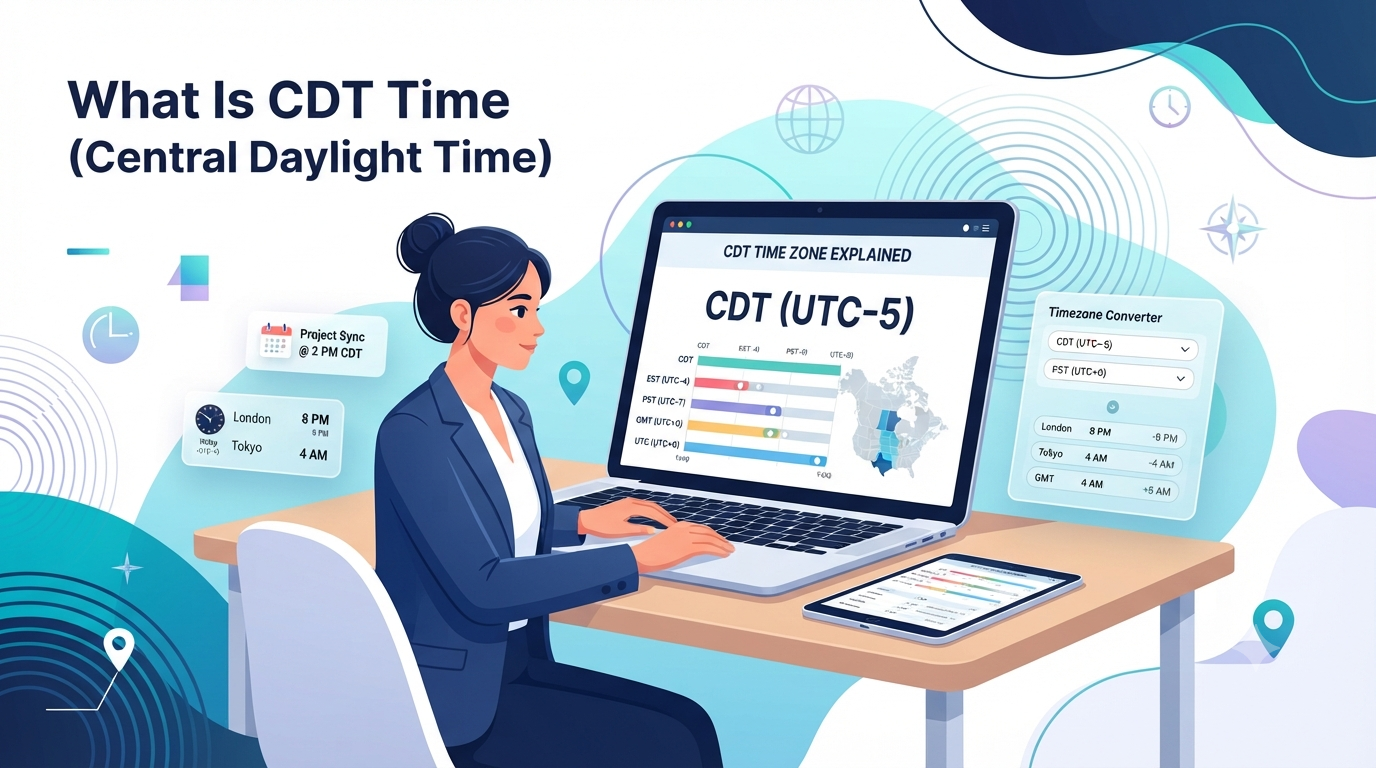
If you've ever scheduled a meeting with someone in the central United States or checked the time for a flight, you've probably come across the abbreviation CDT. But what is CDT time, and how does it differ from other time zones? Central Daylight Time (CDT) is one of the primary time zones used in North America during the daylight saving period. It helps millions of people coordinate business, travel, education, and communication across different regions. However, because the time changes seasonally, many people find it confusing to know when CDT is in effect and how it compares to other time zones. In this guide, we'll explain what CDT means, where it is used, how it relates to Coordinated Universal Time (UTC), and why understanding it is important for anyone working or communicating across time zones. CDT stands for Central Daylight Time. It is the daylight saving version of the Central Time Zone observed in many parts of North America. During the daylight saving season, clocks are moved forward by one hour. This shift allows for more daylight during the evening hours while reducing daylight in the early morning. Central Daylight Time operates at UTC−5, meaning it is five hours behind Coordinated Universal Time (UTC). When daylight saving ends, regions using CDT switch back to Central Standard Time (CST), which follows UTC−6. The concept of daylight saving time was introduced to make better use of natural daylight. Instead of having the sun rise and set earlier in the day, clocks are adjusted forward during the warmer months. The benefits often associated with daylight saving include: More daylight after work or school Better visibility during evening activities Reduced need for artificial lighting Improved opportunities for outdoor recreation Although daylight saving remains widely practiced in North America, not every country or region observes it. Every global time zone is measured in relation to Coordinated Universal Time (UTC), the international standard for timekeeping. Central Daylight Time uses the following offset: CDT = UTC−5 This means that local time in the CDT zone is always five hours behind UTC while daylight saving is in effect. For example: UTC Time Central Daylight Time 12:00 PM 7:00 AM 3:00 PM 10:00 AM 8:00 PM 3:00 PM Knowing the UTC offset makes it easier to convert between different time zones accurately. Central Daylight Time is observed across a large portion of North America during daylight saving months. United States Many states use CDT, including: Texas Illinois Alabama Arkansas Louisiana Mississippi Missouri Oklahoma Iowa Wisconsin Minnesota Kansas Some states are divided between multiple time zones, meaning only certain regions observe Central Daylight Time. Examples include: Florida Indiana Kentucky Nebraska North Dakota South Dakota Tennessee Canada Parts of Canada also follow Central Daylight Time during the summer months. These include areas within: Manitoba Ontario Nunavut Portions of Saskatchewan Because provincial rules may vary, local time should always be verified before scheduling meetings or travel. One of the most common sources of confusion is the difference between Central Daylight Time (CDT) and Central Standard Time (CST). Although they belong to the same Central Time Zone, they are used during different times of the year. Central Daylight Time (CDT) Central Standard Time (CST) UTC−5 UTC−6 Spring and summer Fall and winter Daylight Saving Time Standard Time Clock moved forward one hour Regular local time When daylight saving begins, clocks advance by one hour, changing the time zone from CST to CDT. When daylight saving ends, clocks return to CST. In the United States, Central Daylight Time typically starts on the second Sunday in March. At 2:00 AM, clocks are moved forward one hour to 3:00 AM. This change remains in effect until the first Sunday in November, when clocks are moved back one hour and Central Standard Time resumes. Although these dates are generally consistent each year, it's always wise to confirm current daylight saving schedules if you're coordinating across countries. Understanding how Central Daylight Time relates to other major time zones can make scheduling much easier. Here are some common comparisons: Time Zone Difference from CDT Eastern Daylight Time (EDT) 1 hour ahead Mountain Daylight Time (MDT) 1 hour behind Pacific Daylight Time (PDT) 2 hours behind Alaska Daylight Time (AKDT) 3 hours behind Hawaii Standard Time (HST) 5 hours behind Internationally, the difference depends on whether the other country also observes daylight saving time. Many people regularly convert Central Daylight Time to other global time zones. Some popular conversions include: CDT to Eastern Time Eastern Daylight Time is one hour ahead. Example: 9:00 AM CDT = 10:00 AM EDT CDT to Pacific Time Pacific Daylight Time is two hours behind. Example: 4:00 PM CDT = 2:00 PM PDT CDT to UTC Add five hours. Example: 2:00 PM CDT = 7:00 PM UTC CDT to GMT Since GMT closely aligns with UTC for everyday use, add five hours. CDT to India Standard Time India Standard Time is significantly ahead of CDT. Example: 8:00 AM CDT = 6:30 PM IST Rather than calculating these differences manually, an online time zone converter provides quick and accurate results. Understanding Central Daylight Time isn't only useful for travelers. It plays an important role in everyday life for businesses, students, and remote workers. Knowing CDT helps with: Business Communication Many companies operate across multiple states or countries. Accurate time conversion ensures meetings begin on schedule. Remote Work Distributed teams often include members working from different time zones. Understanding CDT helps everyone stay aligned. Travel Planning Flight departures, hotel check-ins, and transportation schedules often use local time. Knowing whether a destination follows CDT can prevent costly mistakes. Online Learning Students attending virtual classes hosted in Central Time need to convert schedules correctly. Live Events Sports broadcasts, webinars, concerts, and product launches frequently announce times in Central Time. Although you can manually calculate time differences, doing so isn't always reliable. Daylight saving changes, regional exceptions, and international time differences can easily cause confusion. Using a dedicated time zone converter offers several advantages: Instant time conversion Automatic daylight saving adjustments
What Is CDT Time? Understanding Central Daylight Time Read Post »